Water damage can get ugly fast.
A burst pipe, leaking appliance, roof problem, or plumbing failure can send water into flooring, drywall, ceilings, cabinets, insulation, and lower levels of a home before the full scope is obvious. For Pittsburgh homeowners, the first few hours matter because water rarely stays where it starts. It moves. It seeps. It finds the path of least resistance, which is often somewhere behind a wall or underneath a finished floor. The immediate goal is to protect people, stop the water source when possible, and begin residential water mitigation before the damage spreads further.
Stop the Water Source If It Is Safe
The first step is to identify where the water is coming from. If a supply line, appliance connection, or plumbing fixture is responsible, shut off the water when it can be done safely. In some situations, the main water supply may need to be turned off until a plumber can make repairs.
Do not enter areas with standing water near electrical equipment, sagging ceilings, or other obvious hazards. Keep children and pets away from the affected space. If the water is coming through a ceiling, resist the urge to poke around underneath it without understanding what is happening above. Wet building materials can become heavy surprisingly quickly.
Once conditions are safe enough, document the damage with photos and video.
Remove Standing Water and Start Drying
Visible water should be addressed quickly, but removing puddles is not the same as drying a home.
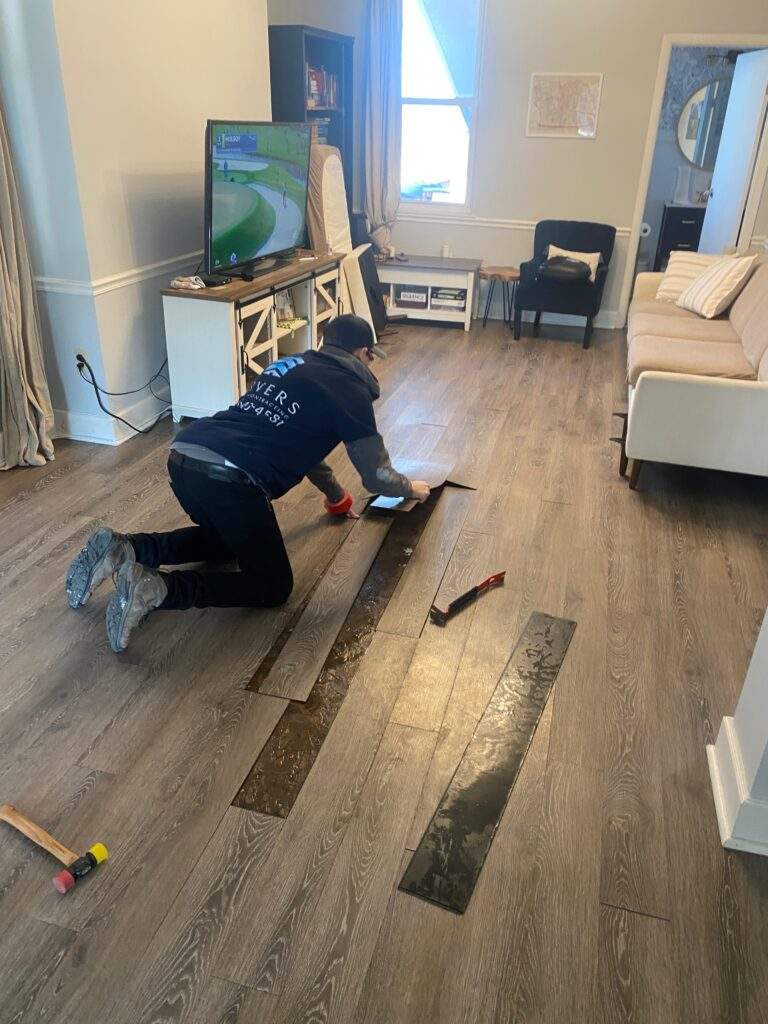
Water can move behind baseboards, into drywall, beneath flooring, and through insulation. A basement may also receive water from an upper-floor plumbing failure long after the original source is shut off. Residential water mitigation may include extraction, structural drying, dehumidification, moisture monitoring, and selective removal of damaged materials.
This is where professional evaluation becomes useful. A room can look better on the surface while hidden materials remain wet.
Around Pittsburgh, older homes can make things interesting. Previous renovations, plaster, multiple flooring layers, finished basements, and concealed wall cavities can give water plenty of places to hide.
Move Belongings Out of Harm’s Way
If it is safe, move furniture, electronics, boxes, rugs, and other belongings away from wet areas. Do not drag items through unaffected rooms if they are saturated or contaminated. Instead, create a controlled area where damaged contents can be evaluated.
Homeowners should also avoid immediately throwing away damaged materials if an insurance claim may be involved. Photograph affected items and building components before disposal whenever practical.
A little organization now can save a fair amount of confusion later.
Find Out What Actually Needs to Be Removed
Water exposure does not mean every wall, floor, or ceiling automatically needs to be demolished.
Some materials may dry successfully. Others may become too saturated, weakened, or damaged to remain. The decision depends on the water source, duration of exposure, material type, and whether moisture can be removed effectively.
Selective demolition may involve portions of drywall, insulation, baseboards, ceilings, flooring, or cabinetry. The objective should be precise removal, not tearing apart the house just because something got wet.
Plan for Reconstruction After Mitigation
Drying the home is not always the final step.
If drywall, flooring, ceilings, trim, or other materials are removed during mitigation, the property will need repairs before those areas are fully usable again. That is where reconstruction begins.
3Rivers General Contracting provides residential water mitigation, restoration, and reconstruction throughout Greater Pittsburgh for eligible property-loss projects. If water has damaged your home, call 412-643-4581 or visit 3riverscm.com.
The first move is simple: stop the source, protect the home, and start drying before a small problem turns into a much bigger one.